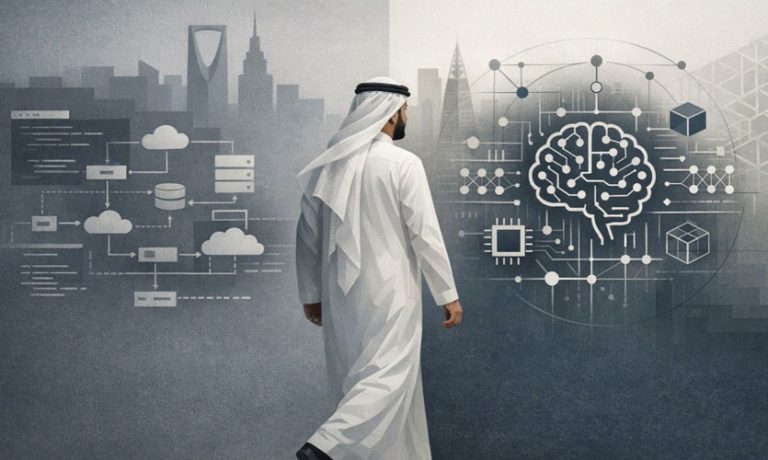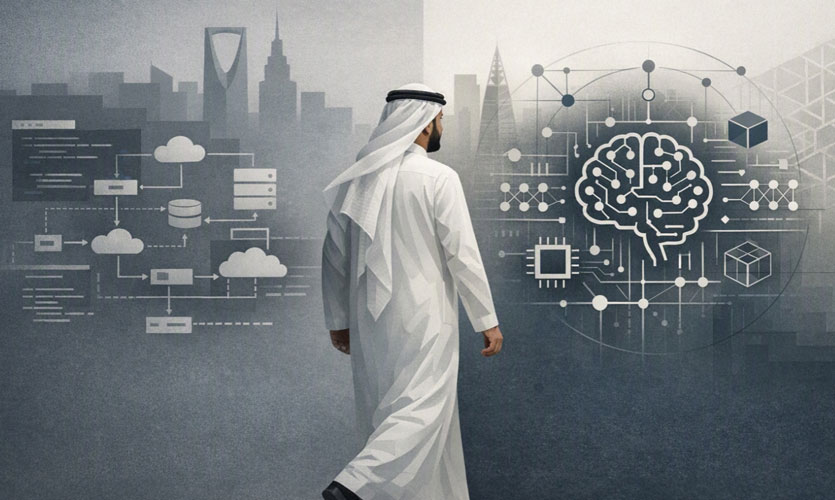


There is a quiet but urgent reality reshaping workplaces across Riyadh, Jeddah, and every major city in the Gulf. Skills mismatches and career transition inefficiencies are costing the Saudi economy an estimated SAR 62 billion in lost earnings for Saudi nationals every year — and that figure rises to SAR 196 billion when non-Saudi workers, Expats are included, equivalent to 4.2 percent of GDP. These are not estimates from a think tank. They come from Pearson’s 2025 landmark report: “Lost in Transition: Fixing Saudi Arabia’s SAR 62 Billion Learn-to-Earn Skills Gap.”
At the same time, more than 150,000 technology jobs are expected to open in the Kingdom in 2026 alone, driven by an 11 percent annual growth in the software market and $11.2 billion invested in digital infrastructure. The roles being created are not the ones disappearing. They require fluency in artificial intelligence.
This is not a warning about robots taking jobs. It is an opportunity statement. The Saudi Data and Artificial Intelligence Authority (SDAIA) has set the goal of training 20,000 AI specialists to fill high-skilled roles by 2030. The Kingdom ranked first in the Arab world and 14th globally for AI strategy development, according to a 2024 UNESCO report. Saudi Arabia also declared 2026 the official Year of Artificial Intelligence.
Here are the seven AI skills that matter most right now — matched to the KSA market, grounded in current hiring data, and framed around what Vision 2030 demands.
Why 2027 Is the Critical Threshold
Vision 2030 is not a distant aspiration. The Public Investment Fund (PIF) has deployed capital into AI, cloud infrastructure, and smart city platforms across the Kingdom. Saudi Arabia secured $1.79 billion in AI-focused funding at the 2025 LEAP tech conference alone. Investments announced at LEAP 2025 in total exceeded $11.3 billion.
By 2027, organizations across government, healthcare, finance, and logistics will have integrated AI tools into daily workflows. The professionals who build AI fluency now will be the ones who shape — rather than respond to — that transition.
The good news: you do not need to become a data scientist. You need to become AI-capable. These seven skills make you that.
The 7 AI Skills KSA Professionals Need Before 2027
1. Prompt Engineering
The ability to communicate clearly and precisely with AI systems, ChatGPT, Microsoft Copilot, Google Gemini ,is already the most transferable skill in any knowledge-work role. Prompt engineering is not a technical skill. It is a communication skill that makes everything else you do faster and sharper.
Government entities aligned with the Ministry of Communications and Information Technology (MCIT) are actively deploying Copilot and AI assistants across Arabic-language workflows. In Riyadh’s financial district, consultants who extract accurate analysis from AI in seconds are outpacing those who write manual reports for hours.
- Estimated KSA salary range: SAR 15,000 – 25,000 per month for roles requiring AI tool fluency
- Entry point: Microsoft Learn (Arabic available), Tuwaiq Academy, and the SDAIA training portal
2. Machine Learning Fundamentals
You do not need to build ML models from scratch — but understanding how they work changes how you evaluate, procure, and manage AI solutions. This is especially valuable for managers, product leads, and policy advisors working on Vision 2030 projects.
KAUST Academy and King Abdulaziz University both offer structured ML programs for Saudi university students and recent graduates. The Saudi government introduced an AI curriculum for over 6 million school students in the 2025–2026 academic year, meaning the next generation enters the workforce ML-literate. Staying competitive means closing that gap today.
- Core areas: Python basics, TensorFlow concepts, supervised vs. unsupervised learning.
- Estimated KSA salary range: SAR 20,000 – 37,000 per month for ML specialists in Riyadh and Jeddah.
3. Data Literacy and Analytics
Data literacy — the ability to read, interpret, and question data — is the foundation every other AI skill builds on. A Konrad-Adenauer-Stiftung policy report on Saudi labor markets identifies
data analytics as one of the three most critical shortage areas in the KSA workforce, alongside AI and cybersecurity.
Tools like Microsoft Power BI, Tableau, and Google Looker are already standard in Saudi enterprises. Saudi Arabia’s ICT sector is valued at over $40.9 billion and expanding at an estimated 22.7 percent annually, creating enormous demand for professionals who combine domain expertise with data fluency.
- Estimated KSA salary range: SAR 14,000 – 22,000 per month.
- Quick start: Microsoft Power BI learning path (free, Arabic available).
4. Cloud AI Platforms (Azure, AWS, Google Cloud)
Saudi Arabia’s $11.2 billion investment in digital infrastructure is built on cloud platforms. Microsoft Azure, AWS, and Google Cloud are the operating systems of Vision 2030’s digital economy. Microsoft has committed to training three million people in Saudi Arabia in cloud and AI skills by 2030.
The AZ-900 and AWS Cloud Practitioner certifications are widely recognized starting points, both completable in under 30 days of focused study. Roles requiring cloud fluency account for a large share of the 150,000+ KSA tech jobs expected in 2026.
- Estimated KSA salary range: SAR 18,000 – 30,000 per month for cloud AI roles.
- Certification shortcut: Azure AZ-900 free study path | AWS Cloud Practitioner Essentials
5. Cybersecurity AI
AI-powered cyberattacks, deepfakes, automated phishing, adversarial inputs, are already targeting GCC organizations. Government entities and PIF-backed companies are prioritizing cybersecurity AI expertise above almost every other technical skill. According to the US Trade.gov ICT Country Guide for Saudi Arabia, cybersecurity spending in the Kingdom is projected to reach $1.8 billion by 2027, up from $1.1 billion in 2025.
Saudi Arabia retained second place in the IMD Global Cybersecurity Index. The Saudi National Cybersecurity Authority (NCA) continuously publishes updated frameworks that define the compliance landscape for enterprises and government entities.
- Estimated KSA salary range: SAR 16,000 – 28,000 per month.
- Key body: Saudi National Cybersecurity Authority (NCA) — follow their published controls frameworks.
6. AI Ethics and Governance
SDAIA has published the AI Ethics Principles and the Kingdom is a signatory to the Riyadh Declaration on AI. As AI is deployed in healthcare, legal, and financial decisions, organizations need professionals who understand responsible AI ,not just technically, but in terms of policy, audit, and compliance.
Saudi Arabia hosts the UNESCO-sponsored International Center for Artificial Intelligence Research and Ethics (ICAIRE) in Riyadh — a direct signal of where global AI governance leadership is being built. Cultural and regulatory context unique to Saudi Arabia creates a genuine local advantage for Saudi professionals in this specialization over imported talent.
- Estimated KSA salary range: SAR 18,000 – 26,000 per month
- Reference framework: SDAIA AI Ethics Principles (PDF)
7. Agentic AI and Workflow Automation
Agentic AI, AI systems that take sequences of actions autonomously without step-by-step human input, is the frontier skill of 2026. Tools like Microsoft Copilot Studio, OpenAI’s operator-mode agents, and low-code automation platforms are replacing manual administrative workflows across every sector.
Professionals who can design, deploy, and oversee these agentic systems are rare, highly compensated, and in demand across government, banking, and logistics in Saudi Arabia. The Kingdom’s National Strategy for Data and AI targets SAR 75 billion ($20 billion) in AI investments by 2030. Agentic AI fluency is the skill that sits at the intersection of every sector targeted by that investment.
- Estimated KSA salary range: SAR 20,000 – 35,000 per month
- Entry point: Microsoft Copilot Studio (free trial) | Make.com AI automation
At-a-Glance: The 7 Skills Summary
| AI Skill | Why It Matters in KSA | Avg. Salary (KSA/mo.) |
| Prompt Engineering | Powers Copilot & ChatGPT in enterprise | SAR 15,000–25,000 |
| Machine Learning | Core to NEOM, health, smart-city projects | SAR 20,000–37,000 |
| Data Literacy & Analytics | Closes SAR 62B nationwide skills gap | SAR 14,000–22,000 |
| Cloud AI (Azure/AWS/GCP) | 150,000+ KSA tech jobs require cloud fluency | SAR 18,000–30,000 |
| Cybersecurity AI | Priority for government & PIF-backed entities | SAR 16,000–28,000 |
| AI Ethics & Governance | SDAIA compliance, Riyadh Declaration | SAR 18,000–26,000 |
| Agentic AI & Automation | Replaces manual workflows across all sectors | SAR 20,000–35,000 |
Your Action Plan: Where to Start This Week
The scale of this list can feel overwhelming, but the right move is to start with the skill that overlaps most with your current role, not to work through a generic curriculum from the beginning.
- Government and public administration professionals: begin with AI Ethics and Governance, then layer in Prompt Engineering for daily workflow tools.
- Finance, consulting, and project management professionals: Data Literacy and Cloud AI are your highest-return investments right now.
- IT, cybersecurity, and engineering professionals: Machine Learning Fundamentals and Cybersecurity AI are your clearest market differentiators.
- Managers and department leads: Agentic AI and automation are what will make you indispensable as AI reshapes your organization’s operating model.
Free and affordable learning is available through SDAIA’s AI academy, Tuwaiq Academy in Riyadh, KAUST Academy programs, and internationally recognized platforms including Coursera, edX, and Microsoft Learn — all of which offer Arabic-language content.
The Vision 2030 Frame: A Workforce Built for What is Coming
Saudi Arabia’s ambition is not simply to use artificial intelligence — it is to lead in it. The Kingdom ranked 5th globally for AI sector growth and 1st in the Arab world on the Global AI Index. More than one million Saudis, the majority of them women, have already been trained in data and AI skills through the SAMAI initiative, described as one of the world’s largest
public AI training programs. Saudi Arabia now leads the world in the female-to-male ratio for AI training.
The SAR 62 billion skills gap is not only a national economic risk, it is a personal opportunity. Every individual who closes their own piece of that gap moves forward in the exact direction Vision 2030 is heading.
The question is not whether AI will reshape your industry. In Saudi Arabia, it already is. The question is whether you will be the one shaping it or the one being reshaped by it.