
The global business intelligence market is worth USD 33.3 billion in 2025 and will continue to expand in 2026, with market reaching USD 37.96 billion in minimum. A 2026 survey found that 68% of organizations admit their current BI platform is not delivering the expected return on investment. The most commonly cited reason is not data quality or budget or choosing the wrong tool for the job.
For data professionals across Saudi Arabia and the GCC, this decision has never mattered more. With data analyst demand up 30–40% since 2023, driven by Vision 2030’s digital transformation agenda, NEOM, fintech growth, and SDAIA’s national data strategy, the tool you specialize in directly affects your salary, your employability, and your organization’s analytical capability.
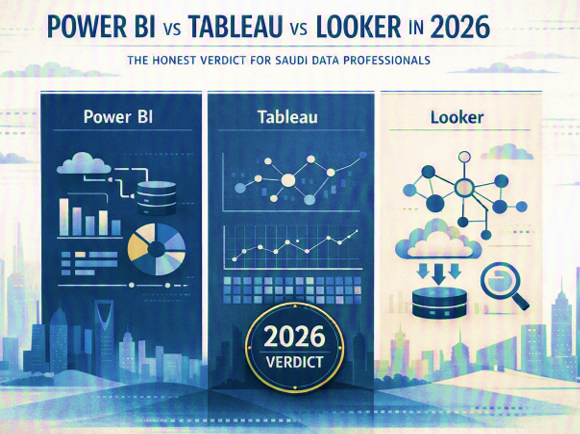
Power BI, Tableau, and Looker are the three dominant platforms. Each is excellent. Each is wrong for certain organizations. Here is the honest comparison Saudi professionals need — with pricing in both USD and SAR, real three-year cost scenarios, and the certification paths that pay.
| Data analyst demand growth in Saudi Arabia 30–40% Since 2023 — driven by Vision 2030, NEOM, SDAIA, and fintech expansion. Mid-level analyst salaries: SAR 14,000–24,000/month 2026). |
The Three Tools and the Three Philosophies Behind Them
Microsoft Power BI; the productivity engine
Power BI is Microsoft’s cloud-first BI platform and the dominant tool in organizations already running Microsoft 365 and Azure. Built around VertiPaq, Microsoft’s in-memory columnar engine, Power BI delivers fast in-memory querying, powerful data modeling via DAX, and native integration with Excel, Teams, SharePoint, Dynamics, and Microsoft Fabric. For Saudi organizations already paying for Microsoft 365, Power BI Pro is included with M365 E5 licenses at no incremental cost, the most compelling total cost argument in the market.
In 2026, Microsoft launched DirectLake in Fabric, a genuine architectural breakthrough that reads directly from OneLake parquet files with no data import and no DirectQuery latency trade-off. Neither Tableau nor Looker can currently match this. Power BI Copilot adds natural-language query, DAX generation, and visual narrative summaries, though Copilot requires Microsoft Fabric F64+ capacity and should be treated as a roadmap accelerant, not a purchase justification on its own.
Tableau; the visualization workbench
Tableau is the undisputed leader in data visualization depth and analyst flexibility. Its drag-and-drop canvas, Level of Detail (LOD) expressions, and pixel-level control over chart design make it the preferred tool for dedicated data analysts who build complex, interactive dashboards as their primary job function. Tableau Pulse, launched in 2025/2026, delivers AI-generated metric summaries proactively via Slack or email, a genuine innovation in proactive analytics.
The honest caveat; Tableau is expensive. Under Salesforce ownership, pricing increased 20–40% at renewal for many organizations between 2024 and 2026. Governance and deployment pipelines, while improved, still trail Power BI’s enterprise maturity. For Saudi organizations where most staff use Windows and are embedded in the Microsoft ecosystem, Tableau’s Mac-compatibility advantage is irrelevant, and the cost premium is hard to justify.
Google Looker; the governed semantic layer
Looker is a fundamentally different product from Power BI and Tableau. Where the other two are primarily end-user BI tools, Looker is a developer-first semantic layer and embedded analytics platform. Its LookML modeling language defines every business metric, what ‘revenue’ means, how ‘active users’ is calculated, once in code, version-controlled in Git, and consumed consistently across every dashboard and application.
Looker’s strength is governance at scale and native integration with Google BigQuery, Vertex AI, and Gemini-powered analytics. Its weakness is cost, enterprise Looker contracts average around USD 150,000/year (approximately SAR 562,500/year) and LookML has a real learning curve that teams without engineering culture consistently underestimate. For most Saudi organizations not already committed to Google Cloud, Looker is rarely the right starting point.
Pricing Reality; What Organizations in Saudi Arabia Actually Pay
List prices are rarely what organizations pay. Here is an honest breakdown of 2026 pricing at 100 users across all three platforms:
| Platform | License type | Cost at 100 users/month | SAR equivalent (~3.75) |
| Power BI | Pro ($10/user/month) | USD $1,000/month | SAR 3,750/month |
| Power BI | Premium Per User ($20/user) | USD $2,000/month | SAR 7,500/month |
| Power BI | Fabric F64 capacity | USD ~$5,000/month (all users) | SAR 18,750/month |
| Tableau | Creator ($75/user/month) | USD $7,500/month | SAR 28,125/month |
| Tableau | Creator + Viewer mix | USD ~$3,500–5,000/month | SAR 13,125–18,750/month |
| Looker | Enterprise (negotiated) | USD ~$12,500+/month | SAR 46,875+/month |
Feature-by-Feature Comparison: What Matters for Saudi Professionals
| Dimension | Power BI | Tableau | Looker |
| Best for | Microsoft-ecosystem organizations | Analyst-heavy visual work | Google Cloud + governed metrics |
| Ease of use | Easy for Excel users | Easiest for visual exploration | Steep — requires LookML/coding |
| Visualization | Strong — improving fast | Undisputed leader | Functional but not beautiful |
| Data modeling | DAX — very powerful | Tableau Prep — good | LookML — best semantic layer |
| AI features (2026) | Copilot (NL queries, DAX gen) | Tableau Pulse (proactive) | Gemini NLQ + Vertex AI ML |
| Governance | Good — needs deliberate setup | Good + Data Catalog add-on | Best — architectural by default |
| Arabic support | Strong — Arabic UI + fonts | Partial | Limited |
| Saudi M365 fit | Native — Teams, SharePoint, Azure | Works — not native | Separate stack required |
| Certification | PL-300 / DP-600 (Microsoft) | Tableau Desktop Specialist | Looker/Google certifications |
| GCC market share | Dominant | Present — analyst teams | Rare — enterprise only |
Saudi Arabia Career Context; Which Tool Pays More?
For Saudi data professionals, the tool you specialize in is a direct salary lever. Mid-level data analysts in Saudi Arabia earn SAR 14,000–24,000/month in 2026, with senior roles in Riyadh reaching SAR 231,000+ per year (approximately SAR 19,250/month). Tool specialization affects where you sit in that range:
- Power BI (PL-300 certified): The highest-volume job postings in Saudi Arabia explicitly name Power BI. Vision 2030 digitization projects across government, healthcare, and banking run predominantly on the Microsoft stack, Power BI fluency directly maximizes employability across the widest range of KSA employers. Monthly salary premium: SAR 2,000–4,000 above non-certified peers.
- Tableau (Desktop Specialist certified): Preferred in consulting firms (Big Four, McKinsey, Accenture, Deloitte) and larger multinational enterprises in Riyadh and Jeddah. Lower volume of postings versus Power BI but consistently higher per-role compensation when the skill is specifically required. Monthly salary range for Tableau specialists: SAR 18,000–28,000 at senior level
- Microsoft Fabric (DP-600 certified): The emerging premium path. Microsoft Data Days 2026 (running June 15 – August 7) offers free Fabric certification exam vouchers, rare in the market and highest-value for organizations planning the Saudi Arabia East Azure region workload migrations in Q4 2026
- Looker: Very limited job postings in the Saudi and GCC market as of June 2026. Specialist Looker skills command a premium when required — but the demand signal is thin outside large multinational technology companies. Not recommended as a primary Saudi career investment in 2026
Five Decision Scenarios for Saudi Organizations
Scenario 1 — You run Microsoft 365 and Azure
Choose Power BI. The integration is native, the additional licensing cost is minimal or zero, and the Power BI Pro certification (PL-300) is the most widely demanded data credential across Saudi organizations. This is the right default for most KSA enterprises in 2026.
Scenario 2 — You have a dedicated analyst team that lives in data
Consider Tableau. If your analysts spend their entire day building complex dashboards, the visualization flexibility and LOD expression power justify the cost premium. Budget SAR 28,000+ per month for Creator licenses for a 10-analyst team and negotiate hard at renewal.
Scenario 3 — You need one source of truth for all business metrics across 500+ users
Evaluate Looker carefully. If your organization has Google Cloud infrastructure, a data engineering team comfortable with code, and a genuine need for metric consistency at scale — Looker is architecturally superior. For most Saudi organizations not already on Google Cloud, the switching cost and LookML learning curve outweigh the governance benefit.
Scenario 4 — You are a data professional choosing what to learn in 2026
Start with Power BI — add Tableau as a secondary. Power BI’s PL-300 certification opens the largest number of Saudi job opportunities. Once proficient, Tableau’s Desktop Specialist certification differentiates you for consulting and multinational roles. The Fabric DP-600 is the highest-leverage emerging credential for 2026–2027.
Scenario 5 — You are a Saudi SME under 200 employees
Power BI Pro — no contest. At SAR 37.50 per user per month (USD $10), the per-user cost is a fraction of Tableau. The Power BI Desktop app is free, built on familiar Excel logic, and sufficient
for most SME reporting needs. Microsoft Fabric capacity becomes relevant at scale, start with Pro and upgrade when you hit the ceiling.
| Situation | Recommended tool | Primary reason |
| Running Microsoft 365 / Azure | Power BI | Native integration — lowest TCO |
| Dedicated analyst teams, complex visuals | Tableau | Best visualization flexibility |
| Google Cloud + metric governance at scale | Looker | LookML semantic layer at scale |
| Saudi SME under 200 employees | Power BI Pro | SAR 37.50/user/month — best value |
| Career choice: Saudi job market 2026 | Power BI (PL-300) first | Highest job posting volume in KSA |
| Emerging career premium credential | Microsoft Fabric (DP-600) | Free vouchers via Data Days 2026 |
- Free certification (limited time): Microsoft Data Days 2026 — free exam vouchers for PL-300 and DP-600
- PL-300 official certification path: Microsoft Learn — Power BI Data Analyst Associate
- DP-600 official certification path: Microsoft Learn — Fabric Analytics Engineer Associate
- Power BI training in Saudi Arabia: Team Academy Saudi Arabia — Microsoft PL-300 training program
- Tableau certification path: Tableau official — Tableau Desktop Specialist
Quick-start: If you are choosing a BI tool to learn: open Microsoft Learn today and enroll in the free Power BI Data Analyst learning path — it takes approximately 8 hours and prepares you for the PL-300 exam. Before June 30, 2026, check Microsoft Data Days for a free exam voucher. If you are choosing a BI tool for your Saudi organization: list your top five data sources — if three or more are Microsoft products, Power BI is your answer before any further analysis.
The Vision 2030 Frame; Data Is Now Infrastructure
SDAIA’s mandate, the National Data Lake integrating 430+ government systems, and the Microsoft Saudi Arabia East datacenter opening in Q4 2026 are all signals pointing in the same direction: data analytics is no longer a back-office function in Saudi Arabia, it is national infrastructure
Qiddiya Investment Company is already querying terabytes of project data across 700 contractors in seconds using Power BI. Government ministries under the SDAIA AI Adoption Framework are required to deploy data-driven decision-making at a governance level. The Saudi organizations that build analytical capability now and certify the teams that run it, will be the ones making faster, better decisions when Vision 2030’s most ambitious projects enter their execution phase.
Power BI wins for most Saudi organizations in 2026. Tableau wins for analyst-heavy specialist teams. Looker wins for the few organizations on Google Cloud with engineering culture and
metric governance challenges at scale. The worst decision is paralysis — choose the tool that fits your stack today and build from there.
References & Sources
All statistics, GCC-specific data, and organizational examples cited in this article are sourced from verified, publicly accessible reports, official announcements, and peer-reviewed industry research