
For most of the last decade, choosing a cloud platform in Saudi Arabia meant making peace with an uncomfortable compromise; the best technology lived outside the country, and keeping sensitive data inside the Kingdom required either private infrastructure or a complex architecture of exemptions and workarounds.
That compromise is ending in 2026. All three major hyperscale’s now have or are about to have in-country infrastructure in Saudi Arabia. The decision is no longer “which cloud can I actually use in compliance with Saudi law?” It is now “which cloud is right for my organization’s specific needs?” — and that is a fundamentally different and more complex question.
Microsoft confirmed in February 2026 that customers will be able to run cloud workloads from the Azure Saudi Arabia East region from Q4 2026, in the Eastern Province, with three availability zones and independent power, cooling, and networking. AWS announced in March 2024 that it will launch an in-country Saudi Arabia region in 2026, backed by a $5.3 billion investment. Google Cloud is already live; its Dammam region opened in November 2023 and expanded with new data sovereignty and AI capabilities in August 2024. In May 2025, Google Cloud and the Public Investment Fund announced a $10 billion AI hub partnership with HUMAIN, near Dammam.
The cloud infrastructure race in the Kingdom is accelerating. Saudi Arabia’s digital transformation market is growing at nearly 20 percent annually, and the cloud sits at the center of every major enterprise and government initiative. Here is an honest, dimension-by-dimension comparison that cuts through the vendor marketing.
The Five Dimensions That Actually Matter for Saudi IT Leaders
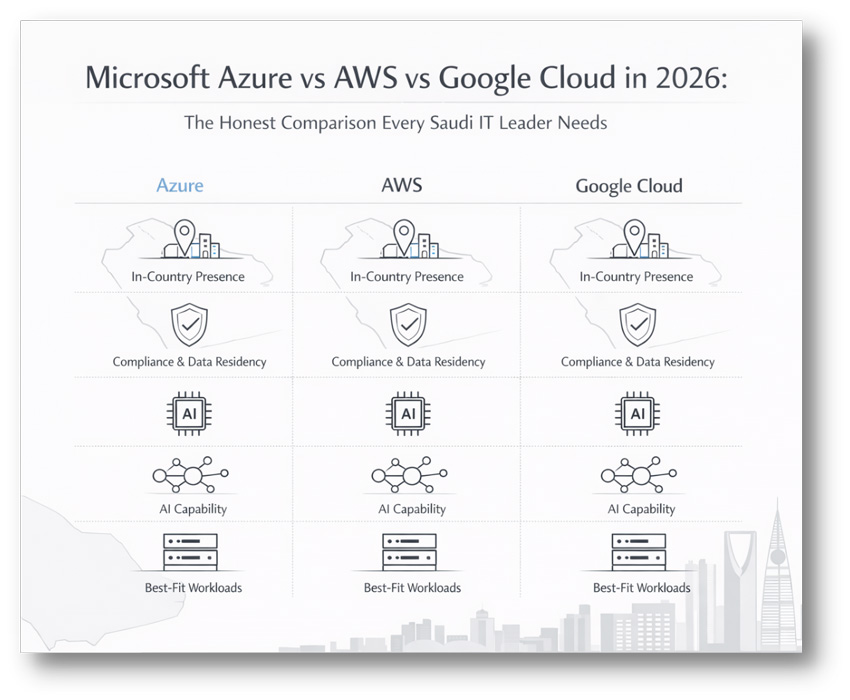
A generic cloud comparison covers compute pricing, storage options, and global reach. Those dimensions matter everywhere. But Saudi IT leaders making cloud decisions in 2026 have five specific priorities that override most of the standard criteria:
- In-country datacenter availability— required for low latency, data sovereignty, and regulatory peace of mind.
- Data residency and SAMA/NCA compliance— non-negotiable for financial institutions, government, and regulated industries.
- Arabic-language AI capability— critical for citizen-facing, employee-facing, and Arabic-first workflows.
- Microsoft 365 and enterprise ecosystem integration— the dominant productivity platform in Saudi organizations.
- Total suitability by organization type— what each provider actually does best for the KSA market.
The analysis below covers each provider against these five priorities, followed by two structured comparison tables.
Microsoft Azure
In-country datacenter
The Azure Saudi Arabia East region is confirmed for Q4 2026, in the Eastern Province, with three availability zones. Construction across all three sites was completed by December 2024. The region will be part of Microsoft’s global cloud infrastructure of more than 70 Azure regions across 33 countries. Until Q4 2026, Saudi organizations using Azure run workloads through UAE North (Dubai), which has been the primary region for GCC customers.
Microsoft has been explicit about what the Saudi region enables; full data residency, low-latency workloads, and the complete Azure services portfolio — including Azure AI services, Azure OpenAI, and Copilot within Saudi borders.
Microsoft Arabia President Turki Badhris stated the confirmation “provides organizations with clarity and confidence as they plan their digital and AI journeys.” [26]
SAMA and NCA compliance
From Q4 2026, Azure will enable financial institutions to meet SAMA’s Cloud Computing Framework requirement for in-kingdom storage of sensitive customer data, transaction histories, and operationally critical records. The NCA’s Cloud Cybersecurity Controls (CCC-2, updated 2024) specifically address data localization requirements that in-country regions satisfy. Microsoft has documented Azure’s alignment with NCA frameworks through its sovereign cloud capabilities.
Arabic AI and ecosystem strength
Azure’s exclusive partnership with OpenAI makes it the primary enterprise platform for GPT-4o, o3, and GPT-5 access via Azure AI Studio. Arabic language support in OpenAI models is strong for Modern Standard Arabic (MSA) and professional contexts. Microsoft Learn is available in Arabic, and Copilot for Microsoft 365 is being actively expanded for Arabic-language enterprise workflows.
The decisive Azure advantage for most Saudi organizations is native Microsoft 365 integration. Teams, SharePoint, Exchange, and the full Copilot ecosystem are Azure-native. For organizations that already run Microsoft 365 — which includes the overwhelming majority of Saudi government entities, banks, and large enterprises, Azure is the path of least resistance and the lowest integration cost.
Amazon Web Services (AWS)
In-country datacenter
AWS announced in March 2024 that it will launch a Saudi Arabia cloud region in 2026, backed by a $5.3 billion investment (approximately SAR 19.88 billion). Until the KSA region goes live, Saudi customers are primarily served through the Bahrain region (me-south-1), which has been AWS’s Middle East anchor since 2019. AWS also has a UAE region (me-central-1) launched in 2022.
AWS will establish two new innovation centers in Saudi Arabia alongside the infrastructure investment and will provide upskilling programs including the AWS Saudi Arabia Women’s Skills Initiative in partnership with Skillsoft.
SAMA and NCA compliance
Until the KSA region launches, financial institutions with strict SAMA in-kingdom data residency requirements face architectural challenges routing sensitive data through Bahrain. From the 2026 KSA region launch, AWS will enable full in-country storage for SAMA-regulated workloads. AWS carries a broad portfolio of compliance certifications globally. For Saudi-specific frameworks, organizations should verify NCA CCC-2 alignment with AWS’s KSA region compliance documentation at launch.
Service breadth and AI capability
AWS’s core competitive advantage is its service depth and breadth: the largest catalogue of cloud services of any provider, with over 200 services covering compute, storage, databases, analytics, ML, IoT, and more. For developers and organizations building custom applications, AWS’s maturity and tooling depth is unmatched. Amazon SageMaker remains one of the most capable managed ML platforms, and Amazon Bedrock provides access to foundation models including Claude, Titan, and Meta Llama 3.1 for enterprise AI.
In Q1 2026, AWS launched Trainium3 AI chips, described as three times faster than Trainium2 for AI training workloads. For organizations building and training their own AI models, AWS’s AI infrastructure investment is significant. Arabic language support via Amazon Bedrock is improving; Alexa Arabic has been available since 2019 but enterprise Arabic NLP maturity lags Azure and Google on formal Arabic content generation.
Google Cloud Platform (GCP)
In-country datacenter — already live
Google Cloud is already operating in-country Saudi Arabia region. The Dammam cloud region opened in November 2023, making it the earliest of the three providers to offer in-kingdom data residency. In August 2024, Google Cloud expanded the Dammam region with enhanced data sovereignty controls, including data residency options, sovereignty keys, and additional security capabilities specifically aligned with Saudi regulatory requirements.
AI and analytics leadership
Google Cloud’s primary competitive advantage is its AI and data analytics stack. Vertex AI, powered by Gemini 2.5, provides one of the most capable enterprise AI platforms available. BigQuery is widely regarded as the fastest and most scalable cloud data warehouse. Google Workspace competes directly with Microsoft 365 for enterprise productivity.
For Arabic AI, Google’s position is improving rapidly. Gemini 2.5 lists Arabic as a core supported language. In October 2025, Google expanded its AI Mode (powered by Gemini 2.5) to support Modern Standard Arabic across more than 200 countries. For organizations where Arabic-language AI performance is mission-critical, the current leader depends on the specific use case: Azure’s OpenAI models and Google’s Gemini both offer strong MSA support, while specialized Arabic models like SDAIA’s ALLaM (available via multiple clouds) offer the deepest cultural alignment.
Google Cloud’s market position is third among the Big Three (11–13 percent global share in Q3 2025), but it is posting the fastest growth rate in percentage terms of any major provider. In Q1 2026, Google Cloud cut compute pricing by 8 percent across all regions, a direct competitive move against Azure and AWS.
The Full Comparison at a Glance
The table below compares all three providers across ten dimensions specifically relevant to Saudi Arabia, with each cell color-coded by provider.
| Dimension | Microsoft Azure | AWS | Google Cloud |
| KSA datacenter (in-country) | Saudi Arabia East — Q4 2026 (Eastern Province, 3 AZs) | Saudi Arabia region — 2026, $5.3B investment | Dammam region — LIVE (opened Nov 2023); $10B AI hub with HUMAIN |
| Data residency | Full in-country from Q4 2026; currently via UAE North region | In-country from KSA region 2026 launch; currently Bahrain | In-country NOW (Dammam); enhanced sovereignty controls added Aug 2024 |
| SAMA compliance | SAMA CSF alignment; in-country storage from Q4 2026 enables full financial data residency | SAMA-aligned; KSA region launch enables in-kingdom hosting for financial institutions | SAMA alignment; Dammam region already supports in-kingdom data residency requirements |
| NCA ECC-2 alignment | Azure Sovereign Cloud capabilities; NCA CCC-2 relevant controls documented | AWS GovCloud-equivalent controls; NCA-relevant compliance certifications | Google Cloud Assured Workloads; sovereignty controls expanded Aug 2024 |
| Arabic AI capability | Azure OpenAI (GPT-4o, o3) — strong multilingual Arabic; Copilot in Arabic for government; Microsoft Learn in Arabic | Amazon Bedrock (Claude, Titan, Llama 3.1); Arabic support improving; Alexa Arabic strong | Gemini 2.5 Arabic support (core language listed); Vertex AI; Google AI Mode Arabic (Oct 2025) |
| Microsoft 365 / Office integration | Native — Azure AD, Teams, SharePoint, Copilot all integrated | Requires connectors / third-party integration | G Workspace integration; limited M365 native support |
| AI / ML platform | Azure AI Studio + Azure OpenAI (exclusive GPT-5 access); Azure Machine Learning | Amazon SageMaker + Bedrock; Trainium3 AI chips (3x faster) | Google Vertex AI + Gemini 2.5; BigQuery ML; strongest for analytics AI |
| Market share (Q3 2025) | 20–24% global; fastest-growing major provider in absolute revenue | 28–31% global; largest provider by market share | 11–13% global; fastest growth rate in percentage terms |
| Best suited for (KSA context) | Government entities, Microsoft-heavy enterprises, Copilot deployments, regulated financial institutions | Startups, developers, maximum service breadth, multi-cloud architectures | Data analytics, AI/ML workloads, Google Workspace organizations, BigQuery users |
SAMA and NCA Compliance: Which Provider Meets What Requirement
For regulated industries in the Kingdom such as banking, insurance, fintech and healthcare, government compliance is not a secondary consideration. It is the first filter. The table below maps six key Saudi regulatory requirements to each provider’s status:
| Requirement | Framework | Azure status | AWS status | Google Cloud status |
| In-kingdom data storage for financial data | SAMA Cloud Computing Framework | Q4 2026 (KSA East region) | 2026 (KSA region launch) | Available NOW (Dammam) |
| 10-year record retention in-country | SAMA AML/CTF Section 6.1 | Q4 2026 | 2026 | Available NOW |
| Cloud service cybersecurity controls | NCA CCC-2 (2024 update) | Azure Sovereign Cloud controls documented | AWS compliance certifications | Assured Workloads + Aug 2024 sovereignty update |
| Personal data protection (PDPL) | Saudi PDPL (2021, enforced 2023) | Azure data residency + PDPL alignment | AWS PDPL-relevant controls | Google Cloud PDPL alignment; Dammam region |
| Government workload security | NCA ECC-2 + Critical Systems Controls | Azure Government Cloud equivalent capabilities | AWS GovCloud-equivalent controls for ME | Google Assured Workloads for regulated sectors |
| Third-party cloud provider audit trail | SAMA CSF + NCA ECC-2 | Azure compliance documentation + audit logs | AWS CloudTrail + compliance reports | Cloud Audit Logs + compliance reporting |
A March 2026 Morgan Lewis analysis of Saudi cloud compliance confirms that the data residency requirements under CITC’s cloud regulations are “among the most expansive in the region”, setting a high bar for providers and noting that where CSP customers are government-linked entities, regulatory obligations may be contractually flowed down to the cloud provider.
Verdicts by Organization Type
The right cloud depends on what your organization does, what you already have, and what you are building toward. Here is an honest verdict by organization profile:
Government entities and Vision 2030 program offices
Best fit: Microsoft Azure. The Saudi government’s MCIT delegation visited the Azure construction site in December 2024. Microsoft has deep integrations with government productivity through Microsoft 365, and its Copilot ecosystem is being extended to Arabic-language government workflows. The Q4 2026 in-country region removes the remaining data residency barriers for government data classification. Azure’s NCA alignment documentation is the most government-specific of the three providers.
Financial institutions regulated by SAMA
Best fit: Google Cloud (now) or Azure (from Q4 2026). Google Cloud’s Dammam region is already live and already offers in-kingdom data residency. For SAMA-regulated institutions that cannot wait for Azure’s Q4 2026 launch or AWS’s 2026 launch, Google Cloud is the only hyperscaler that can meet full in-kingdom hosting requirements today. For institutions that are already Microsoft-heavy and can time their cloud migration to Q4 2026 or later, Azure becomes the strongest option.
Startups, developers, and technology companies
Best fit: AWS or Google Cloud. AWS offers the broadest service catalogue and the most mature developer ecosystem. [20] Google Cloud’s combination of Vertex AI, BigQuery, and Kubernetes (GKE) makes it the strongest choice for data-intensive, AI-first products. Both providers offer competitive free tiers and startup programs. Google’s 8 percent compute price cut in Q1 2026 makes it particularly competitive on cost for compute-heavy workloads.
Organizations with data science, analytics, and AI/ML as core workloads
Best fit: Google Cloud. BigQuery is the gold standard for cloud data warehousing. Vertex AI with Gemini 2.5 is among the most capable enterprise AI platforms. Google’s $10 billion HUMAIN AI hub commitment signals a decade-long investment in the Saudi AI ecosystem. For organizations building Arabic-language AI models or deploying AI across large-scale data pipelines, Google Cloud’s combination of Dammam in-country infrastructure and best-in-class analytics tools is hard to match.
The Multi-Cloud Reality
The honest answer for most large Saudi organizations in 2026 is not one cloud, it is two or three. According to industry data, the Big Three together control roughly 68 percent of global enterprise cloud spending, but large enterprises routinely use multiple providers for different workloads.
A practical multi-cloud pattern for Saudi enterprises:
- Azurefor productivity, collaboration, and Copilot-driven AI (native Microsoft 365 integration)
- Google Cloudfor data analytics, ML model training, and BigQuery workloads (especially now that Dammam is live)
- AWSfor specific services where its catalogue depth is unmatched — IoT, serverless, developer tools — and as a secondary compute option for resilience
The NCA’s CCC-2 framework and SAMA’s Cloud Computing Framework both allow multi-cloud architectures, provided that data classification requirements are met per workload and that organizations maintain clear audit trails across all providers.
What Every Saudi IT Leader Should Do Right Now
The window between now and Q4 2026 is a planning window, not a waiting window. Here are the actions that matter:
- Classify your data by sensitivity and regulatory category.Understand which workloads and data types require in-kingdom storage under SAMA, NCA, and PDPL. This determines your cloud architecture before you select a provider.
- If you are running Azure workloads through UAE North today,begin readiness planning for migration to Saudi Arabia East in Q4 2026. Microsoft has shifted the narrative from infrastructure build-out to organizational readiness: data modernization, governance frameworks, and skills development.
- If you need in-kingdom data residency before Q4 2026,Google Cloud’s Dammam region is currently the only hyperscaler option. Evaluate whether its compliance documentation satisfies your specific NCA and SAMA requirements.
- If your primary workloads are AI and data analytics,evaluate Google Cloud’s Vertex AI and BigQuery stack in the Dammam region against your current analytical architecture.
- For regulated financial institutions,engage your SAMA compliance team now to map your data classification against the hosting requirements under SAMA’s Cloud Computing Framework before selecting or migrating to a provider.
The bottom line for Saudi IT leaders in 2026: Azure leads for Microsoft-heavy enterprises and government entities, with the most anticipated in-country launch of Q4 2026. Google Cloud leads for data analytics, AI workloads, and organizations that need in-country compliance today. AWS leads for developer ecosystems, service breadth, and organizations building maximum flexibility into their cloud strategy. There is no universally correct answer; only the answer that fits the regulatory requirements, existing technology state, and the workloads you are actually trying to run.
References & Sources
All datacenter announcements, market share figures, regulatory requirements, and AI capability assessments cited in this article are sourced from verified, publicly accessible reports, official announcements, and regulatory documentation.