
Three years ago, the phrase ‘agentic AI’ did not appear in a single Saudi government policy document. There was no HUMAIN. There was no Kingdom Digital Twin Summit in Riyadh. Saudi Arabia’s generative AI market was, for practical purposes, a blank page.
Today, Saudi Arabia has declared 2026 the Year of Artificial Intelligence. SDAIA projects AI will contribute 12 percent of the Kingdom’s GDP by 2030. [1] PwC estimates AI will contribute $135 billion to the Middle East economy by 2030, with Saudi Arabia accounting for nearly half of that figure. [6] And 75 percent of Saudis now report strong knowledge of AI and its applications, according to SDAIA’s own public awareness survey. [2]
The transformation is real — and it is being driven by five specific technologies that barely existed in the form we know them three years ago. Each one is already generating measurable economic value inside the Kingdom. Here is what each one is, what it is doing in Saudi Arabia right now, and why it matters to you.
01 Agentic AI — The Workforce Multiplier
What it is
Agentic AI refers to artificial intelligence systems that can plan, reason, and execute multi-step tasks autonomously — without step-by-step human instruction. Unlike a chatbot that answers a question, an agentic AI system receives a high-level goal (‘process this insurance claim’, ‘schedule this patient’s referral’, ‘reconcile these invoices’) and executes the entire workflow end-to-end.
What it is doing in Saudi Arabia right now
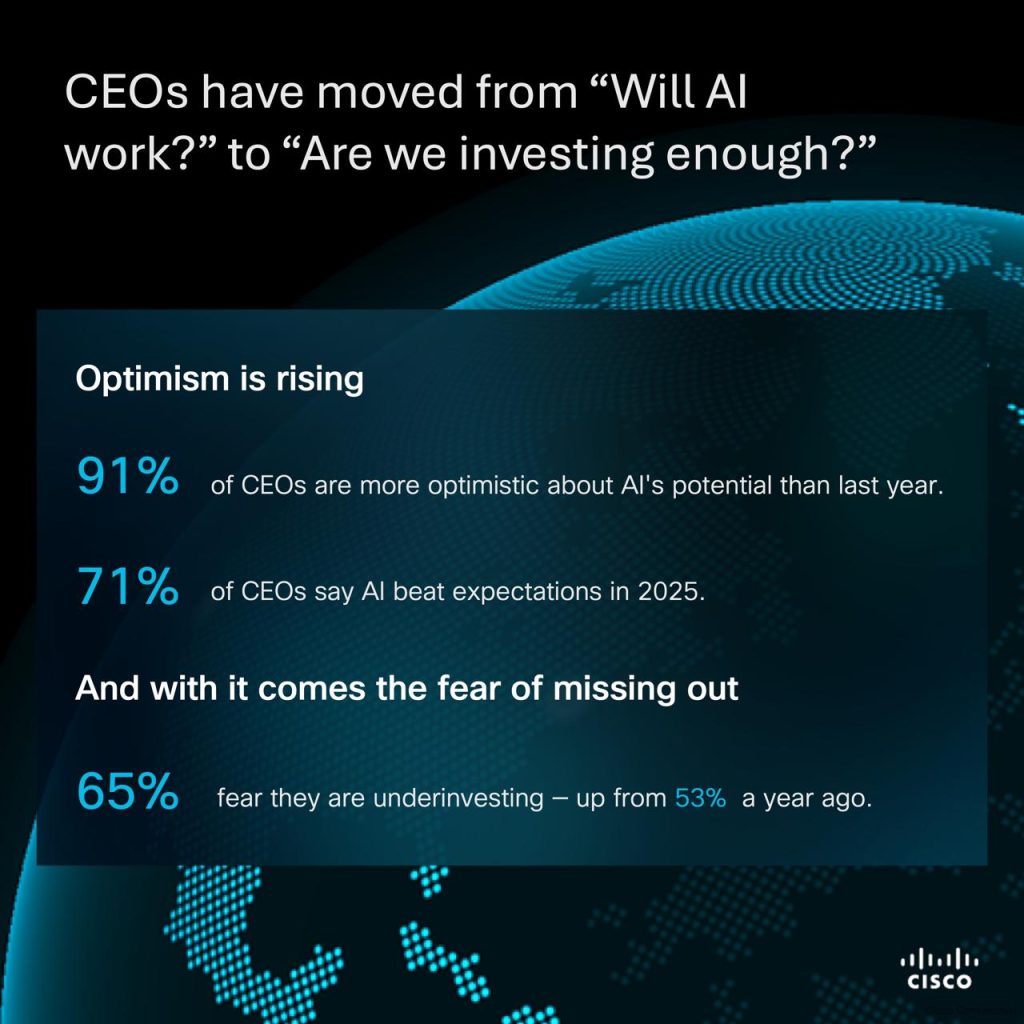
According to Deloitte’s 2025 State of AI in the Middle East Report, more than 80 percent of organizations in Saudi Arabia and the UAE feel intense pressure to adopt AI, with 69 percent planning increased investment in the next 12 months. [7] Consumer adoption is already significantly ahead of Western markets: 58 percent of Saudi consumers are actively using generative AI tools, outpacing the UK and most European markets. [9]
AI-powered agentic system at an Al-Ahsa hospital — ‘Dr. Hua’ — achieves a diagnostic error rate of just 0.3 percent, serving as a model for applying agentic AI to improve healthcare accessibility in underserved areas. [24] In government, Deloitte’s 2026 predictions for the region specifically forecast that government-scale AI deployments will reduce manual workloads by 30 percent across ministries. [11] Saudi Aramco operates 18,000 NVIDIA GB300 supercomputers for energy optimization. [24]
Globally, 79 percent of organizations have adopted AI agents to some extent. The agentic AI global market is projected to grow from $5.2 billion in 2024 to $196.6 billion by 2034.
Why it matters for GCC professionals
Agentic AI is the technology most likely to redefine job roles across every sector in the Kingdom. It does not replace humans — it replaces the manual, repetitive components of human workflows, freeing professionals to focus on judgment, relationships, and strategy. Organizations that adopt it now are building a structural productivity advantage over those that wait.
02 Generative AI and Arabic Large Language Models — The Cultural Bridge
What it is
Generative AI creates new content — text, images, code, voice — in response to prompts. Large Language Models (LLMs) are its foundation. Until recently, almost all LLMs were trained primarily on English data, making them poorly suited to Arabic-language professional contexts. That gap is closing rapidly, and Saudi Arabia is leading the closure.
What it is doing in Saudi Arabia right now
In May 2025, the Public Investment Fund launched HUMAIN — a government-owned company under a Royal Decree — specifically to develop Arabic-first large language models and next-generation AI infrastructure. [12] SDAIA has developed ALLaM, an Arabic LLM now integrated into Qualcomm’s ecosystem, expanding Saudi-generated AI content globally. [13] As of Q1 2025, more than 53 Arabic language models existed worldwide — with Saudi Arabia leading among developing countries in their creation.
The adoption data is striking; in a national survey of Saudis conducted between June and August 2025, 93 percent of respondents actively use generative AI tools, primarily for text-based tasks. [15] A separate Oliver Wyman and SDAIA report estimates generative AI could contribute between SAR 60 billion and SAR 90 billion to Saudi Arabia’s GDP by 2030 — approximately 2 percent of total GDP. [3] Globally, GenAI is projected to save 300 billion work hours annually by 2030.
In 2025, STC Group launched Saudi Arabia’s first sovereign AI cloud platform, featuring enterprise-grade LLM capabilities. Ministries and public sector entities are deploying generative AI for citizen engagement, Arabic document automation, policy analysis, and intelligent virtual assistants across government portals.
Why it matters for GCC professionals
For the first time, the most powerful AI tools in the world are being built in Arabic, by Saudis, for Saudi contexts. This shifts the equation from adoption of foreign technology to ownership of local capability — a fundamental change in the Kingdom’s technology posture.
03 Urban Digital Twins — The Living Model of the City
What it is
A digital twin is a real-time virtual replica of a physical object, system, or environment. Urban digital twins create a live, data-driven model of an entire city or infrastructure system — allowing planners, engineers, and policymakers to simulate changes, predict problems, and optimize resources before anything is built or changed in the physical world.
What it is doing in Saudi Arabia right now
Saudi Arabia’s digital twin technology market is valued at approximately $180 million in 2025 and is projected to reach $1.2 billion by 2033. NEOM — the Kingdom’s $500 billion smart city megaproject — uses digital twin technology at urban scale to simulate energy consumption, water distribution, traffic flow, and disaster response across its entire footprint. Oxagon, NEOM’s industrial zone (partially built on the Red Sea), integrates digital twins with renewable energy, robotics, and cyber-physical systems to streamline operations.
A 2025 peer-reviewed study published in the International Journal of Low-Carbon Technologies (Oxford Academic) identifies Urban Digital Twins as transformative for Saudi Arabia’s smart city ambitions, specifically for optimizing energy consumption, improving smart grid operations, and adopting renewable energy systems aligned with Vision 2030.
Qiddiya Investment Company uses digital twin integration via Microsoft Copilot and Power BI to monitor real-time construction status, invoices, risks, and delays across more than 700 contractors and tens of thousands of workers. The oil and gas sector leads digital twin deployment for asset optimization and predictive analytics, with Saudi Aramco among the most advanced adopters globally.
Why it matters for GCC professionals
Digital twins are not a NEOM-only phenomenon. They are entering construction, utilities, healthcare facilities, and manufacturing plants across the Kingdom. For project managers, engineers, and government planners, digital twin literacy is becoming as fundamental as spreadsheet literacy was a decade ago.
04 Sovereign AI Cloud Infrastructure — The Independence Play
What it is
Sovereign AI cloud infrastructure refers to AI computing capacity that is owned, operated, or regulated within a country’s own borders — ensuring data residency, national security, and independence from foreign technology dependencies. Three years ago, Saudi organizations processing sensitive data through AI had no choice but to route it through foreign cloud infrastructure. That is changing fast.
What it is doing in Saudi Arabia right now
HUMAIN and STC have launched a joint venture to build data centers capable of supporting 1 gigawatt of AI workloads — one of the largest AI infrastructure commitments in the world. SDAIA projects that investments in data centers in Saudi Arabia will reach $15 billion by 2030, increasing capacity to 1,300 megawatts.
Microsoft confirmed in February 2026 that its Saudi Arabia East datacenter region — the first Microsoft cloud region physically located in the Kingdom — will go live in Q4 2026, enabling organizations to run mission-critical AI workloads in-country for the first time.
Saudi Arabia’s cloud market is growing at nearly 23 percent CAGR through 2029, supported by government mandates including e-invoicing (FATOORA), NCA ECC-2 cybersecurity compliance, and NCA data localization requirements. Six global cloud providers now have dedicated Saudi cloud regions.
Why it matters for GCC professionals
Sovereign AI cloud is not a geopolitical abstraction. It has direct operational consequences: organizations in sensitive sectors — government, healthcare, finance, defense — will be able to adopt advanced AI tools that were previously off-limits due to data residency concerns. The Q4 2026 Microsoft launch is a starting gun for a wave of enterprise AI adoption in the Kingdom that has been pent up precisely because the infrastructure did not exist before.
05 AI-Driven Water and Resource Management — The Quiet Revolution
What it is
Saudi Arabia faces one of the most acute water scarcity challenges of any nation on earth. The Kingdom receives an average of 100 millimeters of rainfall per year and relies on desalination for more than 70 percent of its drinking water. Artificial intelligence — applied to desalination efficiency, irrigation optimization, and predictive infrastructure maintenance — is quietly becoming one of the most consequential technologies the Kingdom is deploying.
What it is doing in Saudi Arabia right now
NEOM’s vision includes AI-driven water management systems using IoT sensors to monitor and optimize water distribution, energy consumption, and waste management across the entire city in real time. ACWA Power, one of Saudi Arabia’s largest energy and water companies, uses Microsoft Azure AI services and data platforms for predictive maintenance across its portfolio, maintaining near-continuous operations while applying analytics to optimize energy and water delivery.
Saudi Arabia’s smart city infrastructure now processes more than 3 billion government transactions annually through unified digital platforms, with 5G coverage spanning 75 cities — providing the connectivity backbone for AI-powered environmental monitoring at scale. [21] The Kingdom has climbed 25 places in the UN E-Government Development Index 2024, now ranking 4th worldwide for digital service maturity — the infrastructure foundation on which AI water management is being built.
AI-optimized desalination and irrigation systems are demonstrating energy savings of up to 30 percent in comparable deployments globally — a critical metric for a country where water production is among the most energy-intensive activities in the national economy. [11]
Why it matters for GCC professionals
Water and resource management AI is not a specialist concern — it is a national economic priority. For professionals in engineering, construction, government, and sustainability, understanding how AI is being applied to resource efficiency is increasingly a prerequisite for working on Vision 2030’s largest and most consequential infrastructure programs.
The 5 Technologies at a Glance
| Technology | Key KSA Application | Economic Signal |
| Agentic AI | Government workflow automation, healthcare diagnostics, finance | AI to contribute 12% of KSA GDP by 2030 (SDAIA) |
| Generative AI & Arabic LLMs | HUMAIN Arabic LLM, citizen services, document automation | SAR 60–90B GDP contribution by 2030 (Oliver Wyman / SDAIA) |
| Digital Twins | NEOM urban planning, ACWA Power, water & energy management | $180M market in 2025 → $1.2B by 2033 in KSA |
| Sovereign AI Cloud | HUMAIN / stc 1GW data center, Microsoft Saudi Arabia East | $15B in data center investment by 2030 (SDAIA) |
| AI-Driven Water Management | Smart desalination, IoT irrigation, predictive maintenance | KSA spends ~$1B/year on water tech; AI cuts waste by up to 30% |
What This Means for GCC Professionals and Organizations
The five technologies in this article share a common characteristic: they did not exist in their current, operational form in Saudi Arabia three years ago, but they are producing measurable economic and operational results today. They are not research projects. They are live deployments, at scale, inside organizations that professional readers of this article work in, procure from, or compete with.
For individual professionals, the implication is clear: these technologies will change what is valued in every sector the Kingdom is developing — energy, healthcare, logistics, finance, government, and construction. The earlier you build literacy in the technologies shaping your sector, the stronger your position becomes as Vision 2030 moves from planning into execution.
For organizations, the implication is equally direct: adoption is no longer the question. The question is governance and readiness. The organizations that gain the most from agentic AI, digital twins, and sovereign cloud will be those that pair technology adoption with the data quality, talent, and compliance frameworks needed to sustain it. Those that do not will find themselves running expensive pilots that never scale.
Saudi Arabia’s Technology Window Is Open — and Moving Fast
Saudi Arabia has declared 2026 the Year of Artificial Intelligence. It has launched HUMAIN. It is building 1 gigawatt of sovereign AI compute. It has introduced an AI curriculum for six million school students. It has trained over one million Saudis in data and AI through the SAMAI initiative.
The five technologies in this article — agentic AI, generative AI and Arabic LLMs, urban digital twins, sovereign cloud infrastructure, and AI-driven resource management — are not what Saudi Arabia is planning to do. They are what Saudi Arabia is already doing.
The gap between organizations that understand these technologies and those that do not is widening every quarter. The professionals and enterprises that close that gap now will be the ones shaping the Kingdom’s economy in 2030 — not responding to it.