

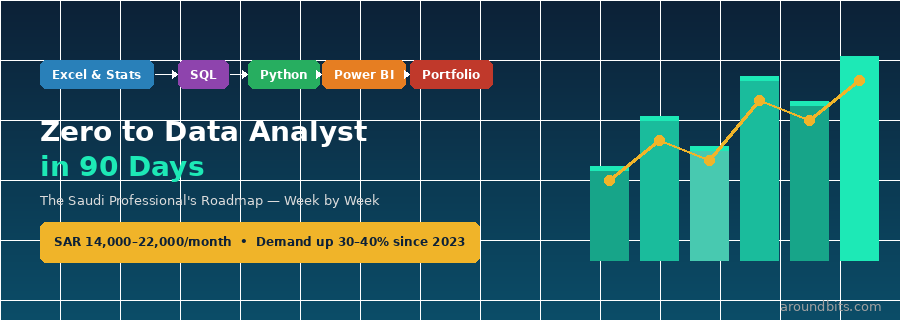
Saudi Arabia’s data analytics market is not growing gradually. It is surging. Fueled by Vision 2030’s digital transformation mandate, investments in fintech, healthcare digitization, e-commerce, and mega-projects like NEOM, the demand for data analysts across the Kingdom has grown 30 to 40 percent since 2023, with salaries rising accordingly.
The technology sector in Saudi Arabia is on track to create 500,000 new IT jobs by 2030, with tech’s contribution to GDP rising to $38 billion. [5] Data analytics is identified as one of three urgent skill shortages in the Kingdom alongside AI engineering and cybersecurity.
Tuwaiq Academy in Riyadh trains more than 1,000 students per day through free courses in data science, Python, SQL, and Power BI. [10] More than 80 percent of its bootcamp graduates secure employment within six months. [13]
Why Data Analytics? Why Now in Saudi Arabia?
The role is in demand across every sector Vision 2030 is developing. Microsoft Power BI is the most in-demand analytics tool in KSA, followed by SQL and Python. Saudization requirements mean Saudi nationals with verified data skills are competing for roles where supply is structurally below demand.
Saudi Arabia’s Pearson-commissioned research found that skills mismatches cost the Kingdom SAR 62 billion annually in lost productivity. Data analytics is one of the sharpest tools for closing that gap.
The 90-Day Roadmap: Five Phases
This roadmap is designed for working adults and recent graduates with no prior technical background. It assumes 1–2 hours of daily study. Each phase builds directly on the one before it.
PHASE 1 | Weeks 1–3 Excel, Statistics, and Thinking in Data
What you learn: Microsoft Excel (advanced functions, pivot tables, VLOOKUP, data cleaning, conditional formatting), Google Sheets, and descriptive statistics fundamentals (mean, median, standard deviation, distributions).
This phase is the foundation. Every data analyst in Saudi Arabia’s corporate market uses Excel daily. The Ministry of Finance, Saudi Aramco, SABIC, banking institutions across Riyadh — Excel is the universal language of business data in the Kingdom.
- Free resource: Microsoft Excel learning path on Microsoft Learn (free, Arabic available)
- Free resource: Saudi Open Data Portal (data.gov.sa) — real datasets for practice
- Milestone: Clean a raw Saudi public dataset, summarize it in 3 pivot charts, and write 3 business insights in plain language.
PHASE 2 | Weeks 4–6 SQL — The Language of Data
What you learn: SQL: SELECT, WHERE, GROUP BY, ORDER BY, JOINs, subqueries, and window functions. SQL is the single most-requested technical skill in data analyst job postings in Saudi Arabia.
SQL requires no software installation. Practice immediately in a browser. The goal is to extract, filter, and aggregate data from any relational database.
- Free resource: SQL for Data Science (UC Davis, Coursera) .
- Free resource: Kaggle SQL Course — fully free, browser-based, project-based.
- Tuwaiq Academy: Structured SQL tracks in Arabic, free of charge.
- Milestone: Answer 5 realistic business questions using SQL on a 10,000-row database. Example: ‘Which product category generated the highest Q3 revenue?’
PHASE 3 | Weeks 7–9 Python for Data Analysis
What you learn: Python fundamentals, then the data analyst’s core libraries: Pandas for data manipulation, NumPy for numerical computation, Matplotlib and Seaborn for visualization. Python is the language of data science and automation across the GCC tech market.
The goal at this stage: write a Python script that reads a CSV, cleans it, analyses it, and produces a chart — automatically. That single capability is the gateway from junior analyst to someone who automates their own work.
- Free resource: Python for Everybody (University of Michigan, Coursera).
- Free resource: Kaggle Python and Pandas courses — free, project-based
- Tuwaiq/Stanford: Machine Learning Bootcamp at Tuwaiq Academy — free for eligible participants.
- Milestone: Python script that reads a public dataset, removes nulls, calculates three statistics, saves a bar chart, and is pushed to GitHub.
PHASE 4 | Weeks 10–11 Power BI — The KSA Market Standard
What you learn: Microsoft Power BI: connecting data sources, building data models, writing DAX measures, creating interactive dashboards. Power BI is the most in-demand BI tool in Saudi Arabia’s enterprise market. [8] The Microsoft PL-300 Data Analyst Associate certification is the most recognized analytics credential in the KSA job market.
This is where your work becomes visible to business stakeholders. A Power BI dashboard translates months of analytical work into a single screen that a non-technical decision-maker can read in 30 seconds. That translation skill — data to decision — is what separates analysts who advance from those who stagnate.
- Free resource: Microsoft Power BI Learning Path (free, Arabic available, maps to PL-300 exam)
- Free tool: Power BI Desktop is free to download, install, and use for all analysis work.
- Milestone: Build a 3-page interactive Power BI dashboard: executive summary page, trend analysis page, drill-down detail page. Publish to Power BI Service.
PHASE 5 | Weeks 12–13 Portfolio, Applications, and the Saudi Job Market
What you do: Publish two complete portfolio projects on GitHub. Optimize your LinkedIn profile with ‘Data Analyst | Power BI | SQL | Python | Riyadh / Jeddah’ keywords.
Tuwaiq Academy’s Employment Program has placed more than 35,000 graduates, with over 80 percent securing employment within six months through employer partnerships with Google, Microsoft, Apple, Amazon, IBM, and Cisco. [13] [10]
- Portfolio project 1: A Saudi market analysis — pick a public dataset from (health, traffic, or retail), produce a full analytical story with a Power BI dashboard and written commentary in both English and Arabic.
- Portfolio project 2: An automated Python report — a script that pulls data, cleans it, analyses it, and saves a summary chart automatically.
- Certifications to target: Google Data Analytics Certificate (Coursera) + Microsoft PL-300 Power BI Data Analyst Associate
The Full 90-Day Roadmap at a Glance
| Phase | Weeks | Tools & Skills | Milestone |
| Foundation | 1–3 | Excel (advanced), Statistics basics, Google Sheets | Clean a real dataset; build 3 charts with written insights |
| Querying Data | 4–6 | SQL (SELECT, JOIN, GROUP BY, subqueries) | Query a 10,000-row database; answer 5 business questions |
| Python for Analysis | 7–9 | Python basics, Pandas, NumPy, Matplotlib | Automate a report from a CSV file using a Python script |
| Visualization & BI | 10–11 | Power BI (required in KSA), Tableau (optional) | Build a 3-page interactive Power BI dashboard from real data |
| Portfolio & Job Prep | 12–13 | GitHub portfolio, LinkedIn, mock interviews | Publish 2 projects; apply to 5 KSA analyst roles per week |
Free and Affordable Learning Resources in Saudi Arabia
Every resource below is either fully free or available at minimal cost. Priority is given to KSA-based institutions and Arabic-language resources.
| Resource | What you learn | Cost | Arabic? |
| Tuwaiq Academy (tuwaiq.edu.sa) | Data science, SQL, Python, Power BI, Google Cloud | Free | Yes |
| SDAIA AI Academy | Data literacy, AI fundamentals, data science tracks | Free | Yes |
| Google Data Analytics Certificate (Coursera) | Full analyst workflow: spreadsheets, SQL, R, Tableau | SAR 180/mo or aid | Partial |
| Microsoft Power BI Learning Path (Microsoft Learn) | Power BI beginner to PL-300 certification | Free | Yes |
| SQL for Data Science (UC Davis, Coursera) | SQL fundamentals to advanced analyst queries | Audit free | No |
| Python for Everybody (U. Michigan, Coursera) | Python fundamentals, data structures, databases | Audit free | No |
| Kaggle Learn (kaggle.com) | Python, Pandas, SQL, data visualization | Free | No |
| KAUST Academy (Data & AI programs) | University-level AI, ML, and analytics specialization | Free (eligible) | Yes |
The Salary Reality: What to Expect at Each Stage
Salary benchmarks for Saudi Arabia’s data analytics market in 2026, based on Glassdoor, ERI SalaryExpert, Jooble, and WUZZUF aggregated data:
- Entry-level (0–2 years, Excel + SQL + basic Python): SAR 6,500–10,000 per month.[4]
- Mid-level (2–5 years, SQL + Python + Power BI + domain knowledge): SAR 14,000–22,000 per month.[1]
- Senior analyst / BI lead (5+ years, team management, strategic insights): SAR 20,000–35,000 per month.[2]
- Data scientist (ML + advanced statistics + engineering): SAR 20,000–37,000 per month.[5]
The salary gap between an analyst who can only use Excel and one who can write Python, build Power BI dashboards, and communicate insights to senior leadership is SAR 10,000–15,000 per month. That is the gap this roadmap closes.
Three Mistakes That Slow Most Saudi Learners Down
- Learning too broadly, too early. Beginners try to learn Python, R, Tableau, SQL, and machine learning simultaneously and master none. This roadmap is sequential by design. Complete each phase before advancing.
- Skipping portfolio building. A candidate with two portfolio projects and no certification will almost always outperform a candidate with certifications and no portfolio in KSA hiring. Employers want to see real work.
- Ignoring the Arabic language dimension. Saudi organizations — especially government entities and publicly listed companies — require analysts who communicate findings bilingually. Build your dashboard reports and presentations in Arabic and English from Phase 4 onwards.
Quick-start for today: Register on Tuwaiq Academy (tuwaiq.edu.sa) and complete the first data science module. Then download Power BI Desktop (free) and open a dataset. Both actions take under 30 minutes and are the difference between reading about a career change and beginning one.
The Vision 2030 Context: The Right Career at the Right Time
Saudi Arabia has declared AI will contribute 12 percent of GDP by 2030. [15] Every government agency, healthcare system, financial institution, and logistics operator in the Kingdom is investing in data infrastructure. But data infrastructure without data analysts is a building without occupants.
The Vision 2030 Human Capability Development Program is explicitly designed to build a data-literate workforce at scale. Saudization requirements in the tech sector mean that Saudi
nationals with verified data skills have structural advantages in a market where supply is deliberately being realigned toward local talent.
Ninety days is not a long time. But 90 days of consistent, structured effort on the right tools — Excel, SQL, Python, Power BI — is enough to transform a professional’s marketable skill set in a country where that transformation has never been more valuable, or more supported.
The roadmap is here. The free resources exist in Arabic and English. The market is hiring. The only remaining variable is whether you start.