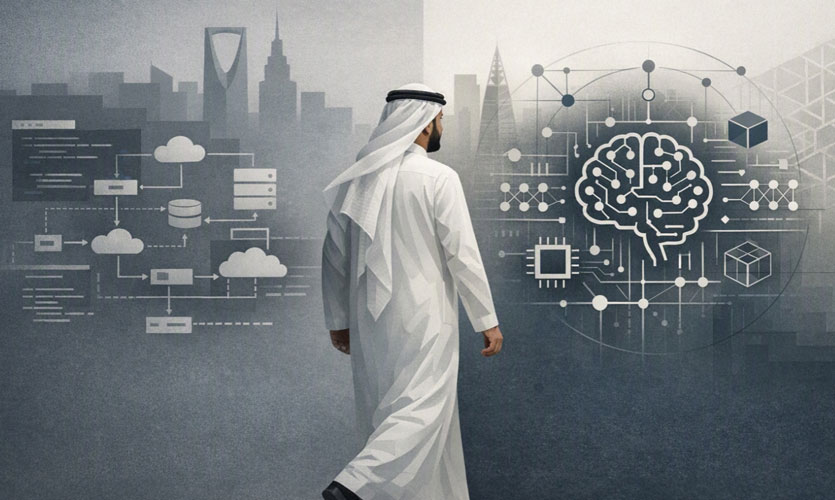

Something historic happened in Riyadh in early 2026. At the PIF Private Sector Forum, Tareq Amin — CEO of HUMAIN, Saudi Arabia’s Public Investment Fund AI company, unveiled HUMAIN OS, an operating system built entirely around artificial intelligence agents. Not a chatbot. Not a productivity addon, not a simple algorithm. An operating system in which you state your intent in plain language, and AI agents plan the work across your entire enterprise automatically.
Then in May 2026, HUMAIN went further; announcing HUMAIN ONE, the industry’s first enterprise-grade operating system for building, deploying, and governing autonomous AI agents at scale, powered by AWS. For businesses in Saudi Arabia and across the GCC, the question is no longer whether agentic AI will affect your organization. The question is whether you will be ready.
What Is HUMAIN, and Why Does It Matter?
HUMAIN is a full-stack artificial intelligence company owned by Saudi Arabia’s Public Investment Fund (PIF). Formed by consolidating the Kingdom’s national AI capabilities, including assets previously linked to Saudi Aramco and Aramco Digital, it builds gigawatt-scale data centers, frontier AI models, and enterprise software.
In January 2026, HUMAIN secured a USD 1.2 billion financing framework to develop up to 250 megawatts of AI data center capacity. By May 2026, it announced strategic collaborations with
McKinsey & Company and Accenture the two firms now serve as primary enterprise adoption partners across the Kingdom.
Why enterprise AI pilots fail 90–95% MIT research cited by HUMAIN CEO Tareq Amin — caused by unclear objectives and fragmented deployment, not technology limitations [4] |
Why HUMAIN ONE Is Strategically Critical for Saudi Arabia
Saudi Arabia declared 2026 the Year of Artificial Intelligence under the patronage of Crown Prince Mohammed bin Salman. HUMAIN ONE sits directly at the center of this strategy, designed to move the Kingdom from AI experimentation to AI execution on a national scale.
GCC sectors most immediately affected:
- Government and public sector: SDAIA’s SAMAI 2 initiative covers 11 ministries — agentic workflows are a procurement priority
- Financial services: Banks operating under SAMA’s framework are integrating AI agents into compliance and customer service operations
- Energy: Saudi Aramco’s digital transformation is directly connected to HUMAIN’s origins and compute infrastructure
- Healthcare: AI-driven diagnostics and patient routing tied to Vision 2030 health digitization targets
- Logistics: NEOM and the Red Sea Project depend on autonomous agentic systems for real-time operations management
What HUMAIN ONE Means for GCC Business Leaders — Six Actions
HUMAIN ONE is being deployed through McKinsey, Accenture, and AWS across Saudi Arabia’s public and private sectors. [2] Forward-thinking leaders are taking preparatory steps now.
- Audit AI readiness: Identify workflows involving repetitive decision-making, document retrieval, or cross-system coordination — these are the first targets for agentic deployment
- Review data governance: Align with SDAIA’s November 2025 AI Adoption Framework, now mandatory for all public sector entities
- Upskill toward agentic roles: Salesforce research predicts 50% growth in data and integration teams as AI agents create new roles: AI integration architects, agent workflow designers, responsible AI officers
- Engage HUMAIN’s partner ecosystem: McKinsey and Accenture are the primary enterprise entry points; HUMAIN’s official page lists current collaboration pathways
- Start with one defined use case: HUMAIN CEO Tareq Amin has publicly warned that broad, undefined AI deployments drive the 90–95% pilot failure rate.
- Align with NCA and SAMA compliance: Agentic AI systems must meet NCA Essential Cybersecurity Controls (ECC 2-2024) and relevant sector frameworks before enterprise deployment
Entity | Role | Function | Status |
HUMAIN ONE + OS | PIF-owned AI operating system | Intent-driven enterprise AI | Live — May 2026 |
SDAIA | Saudi Data & AI Authority | National AI governance | Active since 2019 |
SAMAI 2 | AI workforce literacy | 11 government ministries | Launched 2026 |
NSDAI | National AI Strategy | SAR 74B GDP target by 2030 | 2020–2030 |
Quick-start: Visit HUMAIN’s official partnership page and identify whether your organization qualifies for the McKinsey or Accenture enterprise adoption program. Then run a two-hour internal workshop to list the five workflows in your team most dependent on document retrieval and cross-system coordination — those are your agentic AI entry points.
The Vision 2030 Frame: Agents as Economic Infrastructure
HUMAIN ONE represents a genuine inflection point in how Saudi Arabia and the wider GCC will deploy AI at enterprise scale. It is live, built on AWS infrastructure, and positioned as the first sovereign AI operating system outside the United States and China.
For business professionals across Riyadh, Jeddah, Dammam, and the wider Gulf, the strategic imperative is straightforward; understand what agentic AI can do, map it to your operations, and position your organization to participate, not react. The Kingdom’s Year of AI is not a slogan. It is the deadline.
References & Sources
All statistics, GCC-specific data, and organizational examples cited in this article are sourced from verified, publicly accessible reports, official announcements, and peer-reviewed industry research.