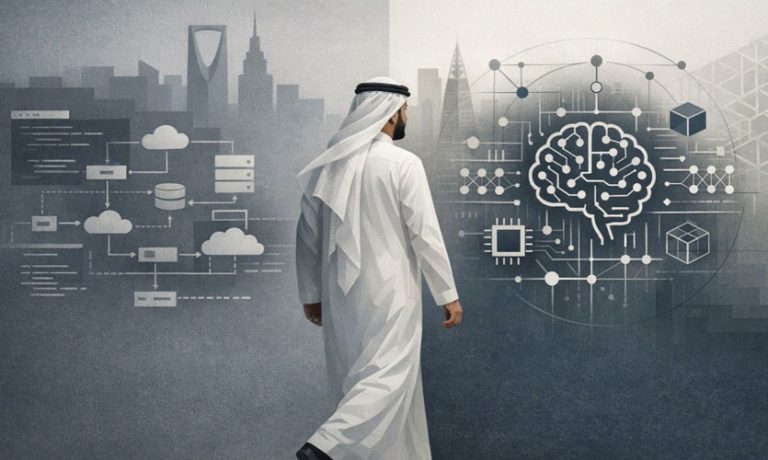

On Tuesday, 10 March 2026, the Saudi Cabinet made an official decision that carries strategic weight far beyond its headline; Saudi Arabia was formally designated the Year of Artificial Intelligence.
This is not branding. It is the formalization of a strategy years in the making, one that has already produced the world’s largest government data center, a national AI operating system, and a workforce literacy program that has reached more than one million Saudis. Here is what it all means, and why it matters to every professional in the Kingdom and across the GCC.
The Numbers Behind the Declaration
Saudi Arabia’s Year of AI designation is backed by verifiable data. Saudi companies in the AI sector secured $9.1 billion in funding across 70 investment deals in 2025, with more than 664 companies currently operating in the data and AI space. [3] Government spending on emerging technologies increased by 56.25 percent in 2024 compared with 2023.
| Metric | Figure | Source |
| Global AI Index ranking | 14th globally | 2025 Global AI Index |
| OECD AI Policy Observatory | 3rd worldwide | OECD, 2026 |
| Arab world AI leadership | 1st in Arab world | Stanford University indicators |
| AI sector funding (2025) | $9.1 billion — 70 deals | SDAIA official announcement |
| Govt AI spending growth | +56.25% (2024 vs 2023) | SDAIA official announcement |
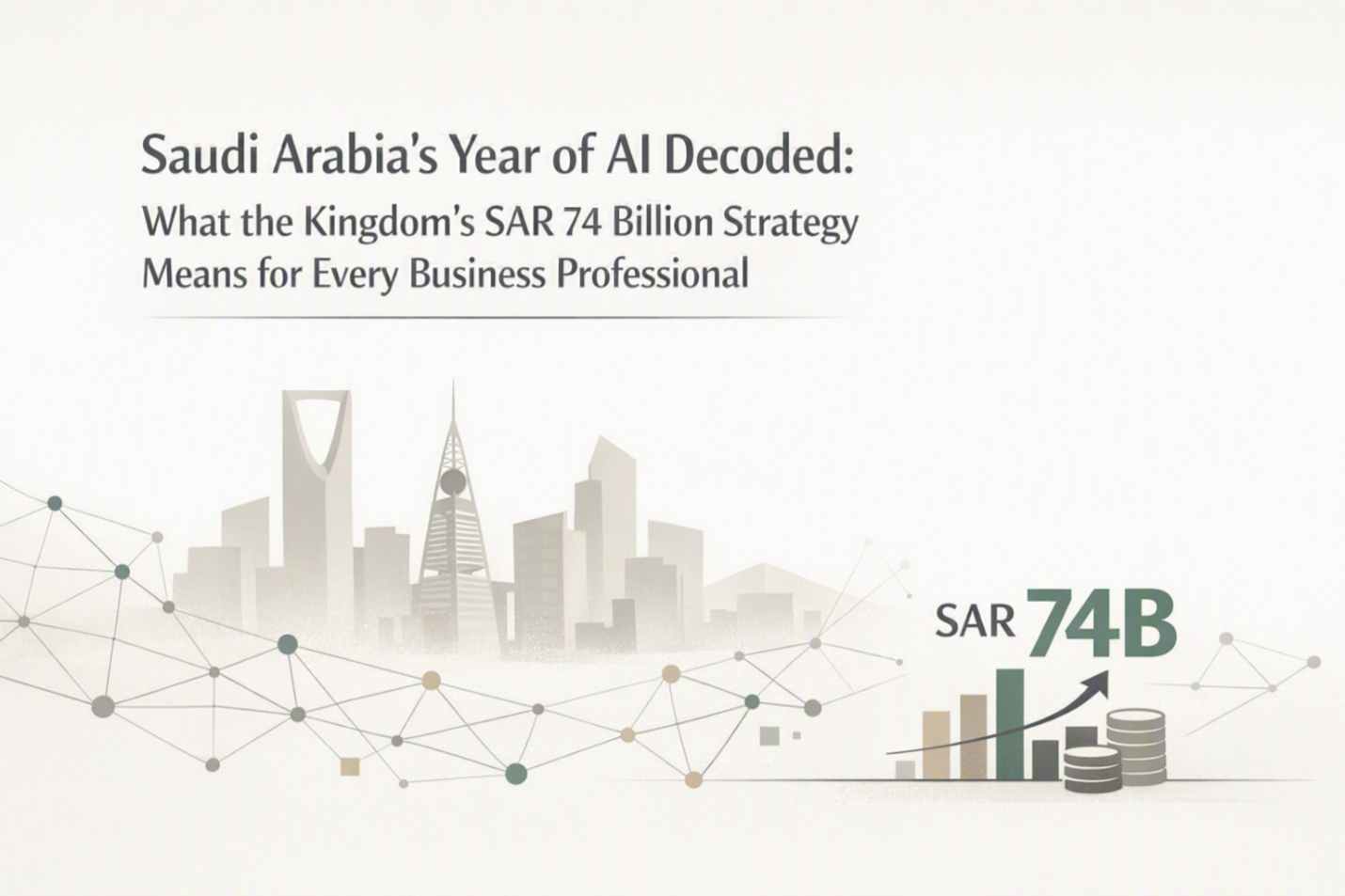
| AI GDP target by 2030 | SAR 74 billion (~USD 19.7B) | National Strategy for Data and AI |
What Is SDAIA? The Institution Running Saudi Arabia’s AI Future
The Saudi Data and Artificial Intelligence Authority (SDAIA) is the Kingdom’s apex AI institution, established in 2019. SDAIA’s authority sharpened decisively in November 2025 with the release of the AI Adoption Framework, a mandatory baseline for all public sector AI procurement. This shifted SDAIA from advisory body to directive regulator.
SDAIA’s six-pillar national AI strategy:
- Ambition — establishing Saudi Arabia as a global AI hub with measurable 2030 GDP targets
- Competencies — building the human capital pipeline through SAMAI, SDAIA Academy, and university partnerships
- Policies — AI Adoption Framework, PDPL enforcement, AI ethics principles, and governance standards
- Investment — $9.1B in 2025 funding, $2.7B Hexagon data center, HUMAIN’s $1.2B financing framework [8]
- Innovation — ALLaM Arabic LLM, SDAIA Applied AI Bootcamp, national AI research programs
- Ecosystem — 664 AI companies, LEAP tech conference, sovereign compute infrastructure
Physical Infrastructure; Scale That Changes the Conversation
| Infrastructure asset | Specification | Status |
| Hexagon Data Center, Riyadh | World’s largest govt data center — 480MW | Operational, early 2026 |
| Shaheen III Supercomputer | National HPC — advanced AI compute | Operational, 2026 |
| National Data Lake | Integrates 430+ government systems | Active, 2026 |
| HUMAIN Core data centers | Gigawatt-scale AI infrastructure | Under development |
| NVIDIA GB300 partnership | Advanced AI chip supply | First shipment Dec 2025 |
SAMAI and SAMAI 2: The Workforce Behind the Vision
SDAIA launched the SAMAI AI literacy program as the first wave, reaching more than one million Saudi participants. SAMAI 2, launched in 2026, expanded the program into 11 government ministries, moving from awareness to applied competency. Beyond SAMAI, over 11,000 specialists have been trained in advanced AI fields, with a national target of 20,000 trained specialists by 2030.
- Free AI training: SDAIA AI Academy
- Free programs in Arabic: Tuwaiq Academy — Data Science and AI tracks
What the Year of AI Means for Business Professionals — Five Immediate Priorities
- Government procurement: The SDAIA AI Adoption Framework is now a mandatory baseline for all public sector AI procurement, compliance is not discretionary
- Enterprise leadership: HUMAIN’s McKinsey and Accenture partnerships mean enterprise AI adoption programs are accessible now, waiting is a strategic cost
- Talent strategy: 50% expected growth in AI-adjacent roles affects hiring plans across technology, legal, finance, and operations
- Upskilling: Arabic-language AI capability is a SDAIA priority — professionals fluent in applying AI tools to Arabic-language workflows have a genuine competitive advantage
- Investment positioning: Generative AI is projected to grow at 47.5% CAGR in Saudi Arabia — the highest-growth segment — driven by Arabic-first LLM demand
Quick-start: Enroll your team in SDAIA’s AI literacy program this month — it is free, available in Arabic, and now referenced in Ministry procurement criteria. Then identify which of SDAIA’s six pillars most directly affects your business sector — that is where the budget and regulation are heading first.
The Vision 2030 Frame: The Opportunity Is Already Here
Saudi Arabia’s Year of AI is not a headline. It is a SAR 74 billion economic target, backed by $9.1 billion in 2025 AI funding, the world’s largest government data center, and a national AI operating system.
For professionals and businesses in Riyadh, Jeddah, Dammam, and across the GCC, 2026 is not the year to observe this from a distance. The SAR 74 billion target is not a government projection. It is an economic signal that the opportunity is here.
References & Sources
All statistics, GCC-specific data, and organizational examples cited in this article are sourced from verified, publicly accessible reports, official announcements, and peer-reviewed industry research.